SUPPLY OF MARINE POWER EQUALISATION SYSTEM
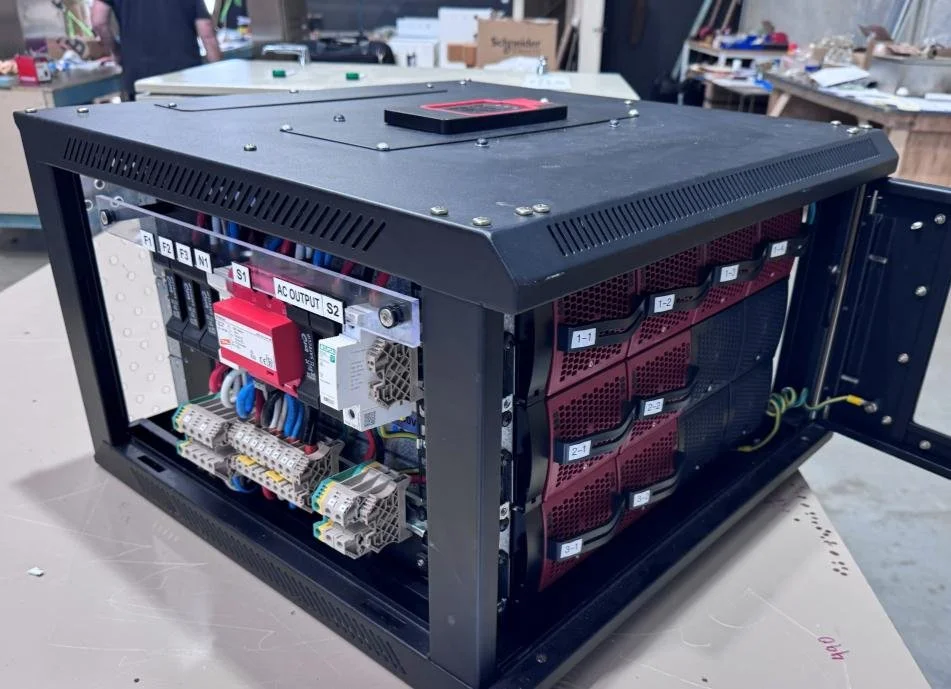
Daronmont sought supply of a power equalisation system that could convert ANEP100 compliant Naval 3 Phase Delta configured, 400VAC, no neutral, no earth power to AS4777 compliant single phase 230VAC power with neutral and earth.
Additional requirements were that the system must be light weight, fit within physical volume constraints, be price efficient, and easily repaired with minimal maintenance.
Jindalee, supported by Nulux manufacturing, designed the concept, conducted digital simulations, manufactured a prototype, proof tested the prototype, manufactured a production system, and supplied the system and full support documents in under 4 months.
The system supplied accept up to 10kW per phase and can optionally provide any or all of three individual 10kW outputs or an unbalanced 3 phase load while always presenting a balanced load to the supply. This balanced load meets the requirements of the Delta supply configuration but also enables Star configured power as the supply and ensures maximum supply balance. Balance is very important for improved diesel generator efficiency and efficient grid connectivity at minimum cost.
System is optionally 50 or 60 Hz and can be supplied with both frequencies for both input and output if required - thus creating an efficient frequency and voltage conversion system.
The key point is that modern switch mode power systems have the capacity to readily adapt a wide range of factors to reliable, light weight, space efficient outcomes.
SUPPLY OF SCALABLE ADAPTIVE HIRE SYSTEMS
A major Australian equipment hire company was seeking options in sizes up to 200kW/ 400kWh for rapidly deployable power systems to work as a hybrid upgrade with on-site generators, peak shave local grid connection and handle unbalanced site loads while enable sizing that could be readily adapted on-site to meet evolving client needs.
Jindalee, again with the assistance of Nulux, developed a modular ISO container system which can be scaled in workshop to maximise capital finance efficiency before deployment and quickly installed on-site with minimal technical workforce. The system can readily be upgraded and can simply handle the presence of local AC solar and such variant loads as site cranes.
Imbalanced loads and volatile pulse loads such as heavy motors startups are easily handled with battery power providing the power inertia required to remove overload on generator or grid.
When paired with a suitable generator, experience has shown potential for 70% specific fuel consumption reduction and substantial more when integrated with site-based AC solar.
The key point is that efficient delivery of affordable power services must still enable simple adaption to changing client needs, ideal within the stride of business activity. Such efficiency should consider both the up front capital cost and the efficiency of consumption of fuel.
SUPPLY OF RESILIENT DISTRIBUTED CAMP POWER
A major camp provider seeking power for widely distributed site camps sought power solutions to be easily deployed to very remote locations in modular configuration, handle a wide variety of loads deployed in imbalanced connection arrangements, integrate local solar to minimise diesel fuel burn and be resilient to potential damage with automated recovery being a central theme of requirement. Occasional requirements existed for supply of extreme pulse loads. Refuel needed to be very efficient with minimal refuel points across the site easily serviced by large tankers. Systems were required to have the power and energy density to avoid excessive demands on limited trucks, vessels and rail.
Jindalee developed a combination or power and energy nodes and mesh interconnectors supported by local, cyber protected control technology to enable the required modularity and resilience while minimising complexity of deployment. The system design implemented ‘graceful degradation’ at many levels thus ensuring maximum continuity of service regardless of unforecast damage.
The design also efficiently implements simple support to heavy loads such as vehicle charging and ready access to retail power for the smallest of personal loads. Through precise management of voltage, control of total harmonic distortion, and avoidance of voltage spikes, the system ensures maximum serviceability of sensitive supported loads such as computers and radios.
The key point is that large remote sites are readily subject to local damage and resilient mesh microgrid power systems can provide effective continuity of service delivery where individual power generation cannot.
INTEGRATION OF STATIC AND DYNAMIC PHASE LOAD EQUALISATION
The client had an installed 3 Phase AC solar system and 3 Phase supply with a variety of single and 3 Phase loads installed. Before equalisation quarterly bills around $3,900.00 even with solar fully operative. This cost resulted inefficient use of solar productivity on site resulting in excessive export and a high level of power purchase.
Following site analysis, we statically realigned loads to better balance across phases and where possible be scheduled to operate within the solar production window. This static phase equalisation resulted in an immediate benefit of costs being reduced to 60% of original.
We subsequently analysed the resultant system performance and have proven that through use of our dynamic phase equalisation system, and without the need to use battery technology we can deliver a further reduction to 57% of the original 60% cost improvement, leading to a residual cost being 34% of the original fee.
The added advantages of our dynamic phase balancing solution are that we can readily upgrade to UPS with addition of a battery and full off-grid independence while driving maximum generator fuel efficiency and carbon reduction through offering a balance load at optimum level to the supplied generator.
The key point is that adding solar to a 3 Phase site without application of effective load balancing will have minimal financial benefit. Solutions are available and they make an effective business case.